
If you’ve been told email marketing is dead for B2B, someone sold you that idea to sell you something else. It’s not dead. It’s just gotten harder to do badly and get away with it. Inboxes are more crowded, spam filters are smarter, and B2B buyers ignore anything that smells like a mass blast. But for the companies doing it right, email is still one of the highest-return channels available because unlike social or paid ads, you own the list, you control the message, and you’re not paying a platform every time you want to reach someone who already raised their hand.
This guide covers how B2B email marketing actually works today, what a good campaign looks like, who you’re actually writing to, and where most companies go wrong.
Is Email Marketing Still Effective for B2B?
Yes, With a caveat. It’s effective when it’s treated as a relationship channel, not a broadcast channel. The B2B buying cycle is long, involves multiple people, and rarely converts off one email. What email marketing does well is stay in front of the right people, at the right stage, with the right message, for as long as that cycle takes.
The companies that say “email doesn’t work for us” are almost always the companies buying a list, sending one generic pitch to everyone on it, and stopping when it doesn’t convert. That’s not email marketing. That’s spam with a template, and it’s part of why deliverability has gotten harder for everyone else, too.
B2B Target Customer Profile
One distinctive feature of B2B email marketing is the audience. A consumer email has one reader who decides on their own. A B2B email usually lands in front of a buying committee, and that committee is made up of people playing very different roles. Writing one email as if a single “customer” will read it is one of the most common reasons B2B campaigns underperform. Before you write a word, it helps to know who’s actually in the room:
- Initiators: whoever first stumbles onto your company and gets curious enough to look closer e.g. the person who downloads the guide or forwards your webinar invite to the team. Email takeaway: this is the only role where a broad, top-of-funnel message actually works. Save the specifics for everyone downstream of them.
- Users: the people who’ll actually be logged into your product every day if the deal goes through. Email takeaway: they respond to proof of ease, not proof of ROI. Release notes and “here’s how it works” content earn more trust from this group than any case study will.
- Buyers: handle the paperwork side of the purchase e.g. budget lines, contract terms, renewal dates. Email takeaway: vague pricing language loses this group fast; the moment they’re in the sequence, get specific about cost, terms, and timeline instead of dancing around it.
- Deciders: are the people who ultimately decide whether or not to approve the buyers to move forward with a purchase. Email takeaway: they’re usually the least engaged with your day-to-day emails and the most swayed by one well-placed proof point, so don’t waste your best case study on a nurture email they’ll never open. Save it for the one email built for them.
- Gatekeepers: often executive assistants or ops staff. They control what actually reaches the people above. Email takeaway: if your subject lines and preview text don’t make the value obvious in three seconds, this is the role that quietly deletes you before anyone else on the list sees it.
- Influencers: everyone else in the building whose opinion carries weight; could be one person, could be half the office. Email takeaway: this is where shareable content earns its keep; a piece that’s easy to forward internally does more work than a piece written only for the person who receives it.
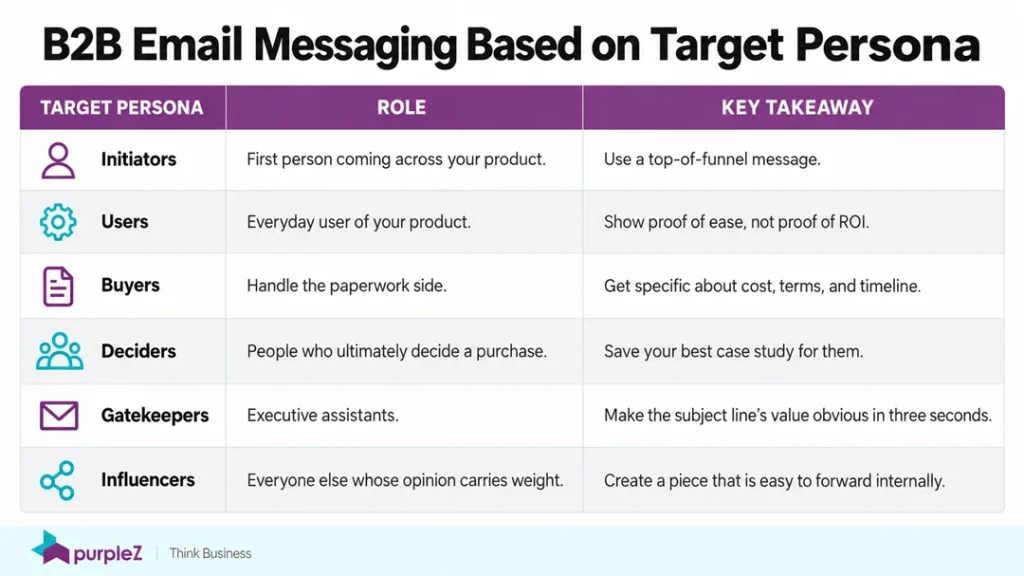
A single deal might touch all six roles, and they rarely need the same information. An Initiator wants to understand what the product does. A User wants to know it won’t make their job harder. A Buyer wants pricing and contract terms. A Decider wants proof it’s worth the budget. Sometimes in a company one person may take responsibility for more than one of the profiles above depending on the size of the company.
How to Do B2B Email Marketing
Build a list that actually wants to hear from you
The single biggest difference between B2B email that works and B2B email that doesn’t is the list. A list of 500 people who opted in because they downloaded something useful will outperform a purchased list of 50,000 every time. A smaller, engaged list will out-open, out-click, and out-convert a larger, cold one, and it’ll keep your domain out of the spam folder.
Segment by where the buyer is in the decision
A prospect who just downloaded a guide and a prospect who’s had three sales calls should never get the same email. Segment your list by:
- Stage: new lead, mid-funnel, sales-qualified, existing customer
- Role: where they sit in the buying center; an Initiator and a Decider often need different messages entirely
- Industry or use case: relevant if you serve multiple verticals
Write subject lines a busy executive will actually open
B2B inboxes belong to people who get well over a hundred emails a day and never open them. Subject lines that sound like marketing get ignored. Subject lines that sound like a colleague sent them get opened.
How to Design Effective B2B Email Marketing Campaigns
Structure your campaign around the sales cycle, not a calendar
A lot of companies build their email calendar the way they’d build a content calendar. One email a week, whatever topic is up next. That works for consumer brands. It doesn’t work for B2B, where the reader’s timeline is dictated by their budget cycle, not yours. Instead, build campaigns around triggers: someone downloads a resource, someone goes quiet after a demo, someone’s contract is coming up for renewal. Each trigger gets its own short sequence, not a slot in a generic weekly send.
Design for the inbox preview, not the newsletter
Most B2B recipients decide whether to open an email based on the sender name and the first line of preview text; not a beautifully designed template. Heavy design, in fact, often hurts B2B email, because it reads as “marketing” instead of “message.” Plain-text or lightly-formatted emails that look like they came from a person tend to outperform designed HTML templates for outbound and nurture sequences. Save the polished design for newsletters and product announcements, where readers already expect a branded look.
Mobile matters here too
more than half of all B2B email is now opened on a phone, so a template that only looks right on desktop is already losing a chunk of its audience before anyone reads a word.
B2B Email Content Structure
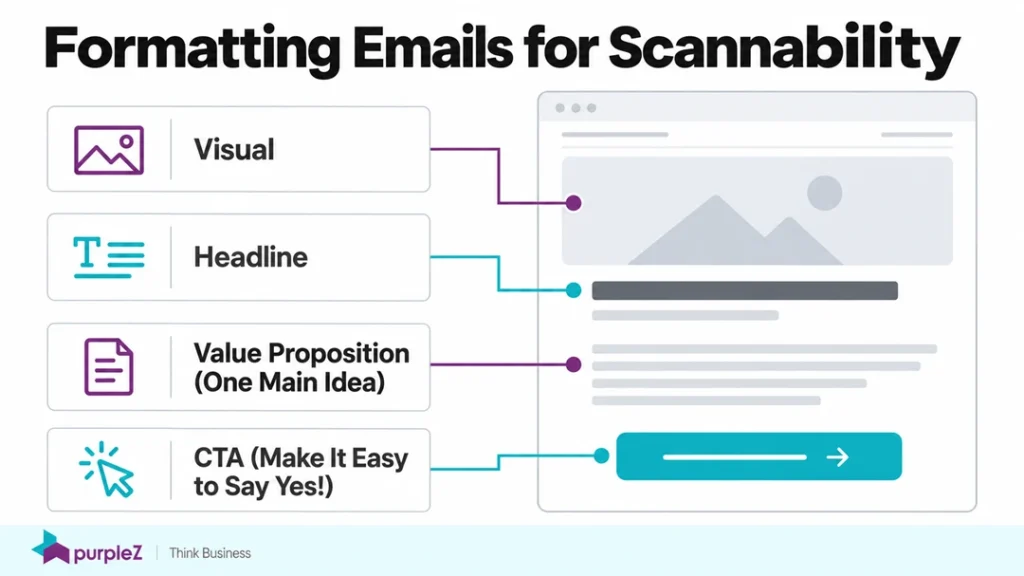
Once you know who you’re writing to, the individual email itself needs a shape. Good B2B emails tend to follow the same three-part structure.
Beginning
The opening line has one job: earn the next sentence. Skip the throat-clearing “I hope this finds you well,” no lengthy self-introduction. Lead with the reason you’re writing, ideally tied to something specific to the reader: a resource they downloaded, a page they visited, a milestone in their contract. This is also where the subject line and preview text do their work; the beginning should deliver on whatever they promised, not pivot to something else.
Middle
This is where the actual value lives; the insight, the case study, the answer to the objection, the update. Keep it to one idea. A common failure mode in B2B email is trying to cover three topics in one send because it feels efficient; it isn’t. One clear idea, explained well, outperforms three ideas explained briefly. If you’re including a link, make it obvious what happens when they click it.
Ending
One call to action stated plainly: reply to this email, book fifteen minutes, read the full case study, register for the session. Multiple competing CTAs split attention and reduce the odds that any of them get taken. Close the way to make it easy to say yes with a low-effort next step, not “let us know if you’re interested.”
B2B Email Marketing Campaign Examples
Here’s what these principles look like in practice:
The post-demo nurture
A prospect takes a demo but doesn’t buy immediately. Instead of one generic “checking in” email, a short sequence goes out over a few weeks: a recap of what was discussed, a relevant case study, an answer to a common objection, and a direct offer to reconnect.
The re-engagement sequence
A segment of the list hasn’t opened anything in 90 days. Rather than continuing to send them the same content as everyone else, a short sequence asks directly: is this still relevant to you? This protects sender reputation and often surfaces leads who were never removed from a list they’d mentally checked out of; cleaning that segment out (or re-engaging it) is one of the highest-leverage things a B2B list can do for its own deliverability.
The customer expansion email
An existing customer using one product or service gets a short, specific email about a second offering relevant to their industry; not a generic upsell blast, but something clearly written for their use case and timed around a milestone, like a renewal date or a usage threshold.
Live events and webinars
Registration notification, confirmation, and post-event follow-ups form one of the most natural sequences in B2B email. The follow-up email -with a recording link and one clear next step- often outperforms the original invitation, since it reaches people who were interested enough to register but couldn’t make it live.
Release notes
A short, plain-language email whenever you launch something new keeps existing customers engaged without asking them for anything. This works especially well for Users in the buying center, who care less about pricing and more about whether the product just got easier to use.
FAQs
Does B2B email marketing work?
Yes, when it’s built around segmentation, B2B target persona and timing rather than one-size-fits-all blasts. Companies that treat it as an ongoing relationship channel -rather than a one-off campaign- consistently see it rank as one of their highest-ROI marketing channels, with typical returns in the $36–42 per dollar spent range.
Where can small businesses find B2B email marketing services?
Most small businesses find this through a digital marketing agency that offers email as part of a broader service. If you are looking for a reliable agency that provides B2B email marketing services, PurpleZ is a great choice.
How do you measure B2B email marketing success?
Build your list through gated resources, webinar sign-ups, demo requests, and events; anything where someone raises their hand because they’re actually interested in what you do.
How do you measure B2B email marketing success?
Open rate isn’t reliable anymore. Apple Mail Privacy Protection auto-opens emails automatically, so it reflects deliverability more than actual engagement. Focus instead on click-through rate and conversion rate (demos booked, meetings set) as your core signals, watch unsubscribe rate as an early warning if it creeps above ~0.3%