
Evaluating the advantages and disadvantages of email marketing requires examining unit economics, technical authentication, and statutory liability. Permission-based lists cut acquisition costs, while compliance failures risk blacklisting. Assessing the pros and cons of email marketing guides budget allocation.
Key Advantages of Email Marketing
Core benefits include audience ownership, low overhead, and clear revenue attribution. Per industry benchmark research, brands earn $36 per dollar spent without recurring auction fees.
1. Exceptional Return on Investment (ROI)
Email outperforms paid ads because messaging opted-in contacts costs fractions of a cent. When evaluating the pros and cons of email marketing, finance teams value this predictable margin.
Industry ROI Benchmarks: Generating $36 to $42 per Dollar Spent
Email ROI distribution studies report $36 back per dollar spent, reaching $42 in retail and B2B. Partnering with email marketing services compounds returns.
Low Cost per Acquisition (CPA) Compared to Paid Channels
Paid ads require continuous bidding that inflates acquisition costs quarterly. Email shifts economics from renting clicks to nurturing leads at fixed software pricing.
2. Full Ownership of Your Audience and Distribution Channel
Owning your subscriber database grants portable contact access regardless of platform changes. Weighing the advantages and disadvantages of email marketing shows why first-party data hedges against risk.
Eliminating Vulnerability to Social Media Algorithm Shifts
Social networks throttle organic reach to sell ads, forcing repeat spend. A verified opt-in list bypasses feed algorithms and reaches inboxes directly.
Building a Direct, Permanent Business Asset
An authenticated list with zero-party preference data forms tangible intellectual property. When switching platforms, you export every contact, purchase tag, and consent timestamp.
3. Hyper-Personalization and Precision Audience Segmentation
Segmentation groups contacts by purchase behavior, geography, and funnel stage. Targeted messages sent to narrow cohorts convert far higher than generic broadcasts.
Dynamic Content Customization by Behavior and Demographics
Dynamic blocks swap recommendations inside one template. Our guide on B2B email marketing that converts explains how buying committees require role-specific proof points.
Lifecycle Triggering: Delivering the Right Message at the Right Stage
Checklist downloaders need educational context, whereas buyers reviewing contracts need transparent pricing. Mapping sequences to lifecycle stages prevents premature pitches.
4. Automated Workflows and Scalable Communication
Automation executes multi-step sequences for thousands of prospects simultaneously without manual effort. Evaluating the pros and cons of email marketing highlights how event-driven workflows nurture leads and recover revenue continuously.
Automated Welcome Series and Onboarding Nurture Sequences
The first 48 hours after opt-in represent peak interest. A three-part welcome sequence confirms preferences, delivers the lead magnet, and introduces core capabilities.
Event-Triggered Campaigns (Abandoned Cart, Re-engagement, Milestones)
Behavioral triggers fire when a user abandons checkout, hits a usage threshold, or approaches renewal. Pairing automated triggers with conversion rate optimization services removes landing page friction.
5. Granular Tracking, Testing, and Measurable Analytics
Email tools log deliveries, clicks, and checkouts per contact. Reviewing the advantages and disadvantages of email marketing confirms few channels offer such controlled testing.
A/B and Multivariate Testing for Continual Optimization
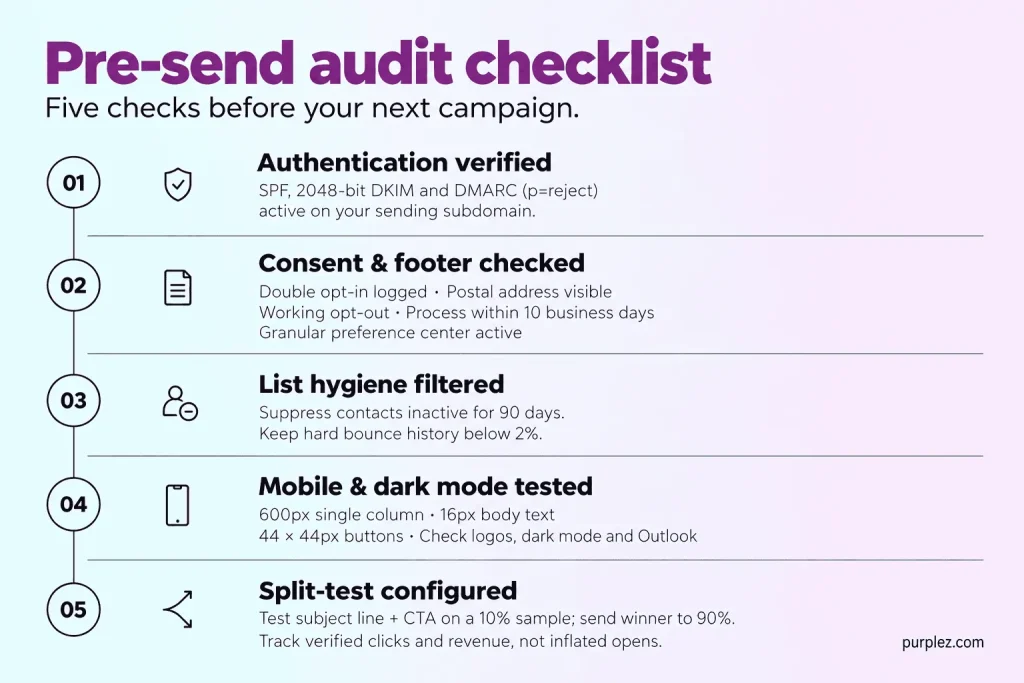
Marketers test subject lines and call-to-action placement on a 10% sample before sending the winner to the remaining 90%, compounding gains.
Tracking Real-Time Metrics: Open Rates, Click-Through Rates, and Revenue
Because privacy proxies inflate open rates, analysts prioritize click-through rates, replies, and attributed revenue while keeping unsubscribes below 0.3%.
6. Direct, Permission-Based Customer Connection
Permission-based outreach reaches people who requested updates. Analyzing the pros and cons of email marketing confirms explicit consent outperforms interruption ads.
Engaging an Audience That Explicitly Opted In
A list of 500 prospects opted in via a webinar or calculator out-clicks and out-converts 50,000 cold contacts because subscribers recognize your sender name.
Cultivating 1-to-1 Customer Loyalty and Brand Trust
Plain-text or lightly formatted emails written in a direct voice read like notes from a colleague, building long-term retention.
7. Cost-Effectiveness and High Scalability for All Business Sizes
Whether sending 2,000 newsletters or 2,000,000 receipts, marginal costs stay low. Teams launch lean sequences before scaling into enterprise platforms.
8. Seamless Integration with Modern Tech Stacks (CRM, CDP, and E-Commerce)
Bidirectional APIs connect email tools with CRM systems, billing software, and storefronts. When a sales rep updates a deal stage, the engine suppresses redundant pitches and triggers onboarding.
| Operational Dimension | Key Advantages (Unit Economics and Control) | Key Disadvantages (Technical and Legal Liability) | Primary Mitigation Action |
| Financial Return vs. Regulatory Exposure | Generates $36 to $42 per $1 spent with near-zero marginal distribution cost | Up to $53,088 per email in CAN-SPAM fines, 20 million euros (or 4% global turnover) under GDPR, and $2,500 to $7,500 per CCPA violation | Log double opt-in timestamps, display a physical postal address, and honor opt-outs within 10 business days |
| Audience Ownership vs. Database Churn | 100% portable first-party contact records and zero-party preference tags immune to social feed algorithms | 20% to 25% natural annual list decay and ISP throttling if hard bounces exceed 2% | Run a 90-day re-engagement sequence, suppress unresponsive contacts after 14 days, and replenish leads via SEO content writing services |
| Automation Scale vs. Authentication Barriers | 48-hour automated welcome sequences and behavioral checkout recovery workflows operating continuously | Mandatory DNS configuration for SPF, 2048-bit DKIM, and DMARC plus BIMI logo validation to avoid junk folders | Enforce a strict DMARC reject policy (p=reject) on a dedicated sending subdomain per CISA directives |
| Performance Tracking vs. Rendering Bugs | 10% sample split-testing on subject lines and CTAs before 90% rollout, tracking verified clicks and revenue | Proxy-inflated open rates, desktop Outlook word-processing rendering quirks, dark mode color inversion, and mobile viewport cutoffs | Build single-column 600px layouts with 16px fonts and 44x44px touch targets, and keep campaign unsubscribes below 0.3% |
Key Disadvantages of Email Marketing
Core drawbacks include strict authentication, regulatory fines, inbox clutter, and list churn. Studying the advantages and disadvantages of email marketing prevents underestimating compliance demands.
1. Deliverability Hurdles and Aggressive Spam Filtering
Even permission-based campaigns land in junk folders if a sending domain lacks cryptographic verification. When comparing the pros and cons of email marketing, deliverability maintenance represents the steepest technical barrier.
Sender Reputation, Hard Bounces, and Spam Trap Pitfalls
Mailbox providers score every sending IP and domain on spam complaints, bounce rates, and spam traps. Mailing unverified lists spikes hard bounces above 2% and triggers domain throttling.
2. Strict Privacy Regulations and Legal Compliance Risks
Privacy statutes across North America and Europe mandate clear sender identification, consent logs, and fast opt-outs. Violations trigger per-message civil penalties.
Navigating Global Data Privacy Laws: GDPR, CAN-SPAM Act, CASL, and CCPA
Cross-border sends must satisfy overlapping laws. European subscribers require affirmative opt-in under GDPR email consent standards, while US messages must follow the FTC CAN-SPAM compliance guide with a postal address and 10-day opt-out processing.
Hefty Financial Penalties and Legal Liability for Non-Compliance
Under FTC CAN-SPAM rules, violations carry fines up to $53,088 per email. EDPB fine guidelines reach 20 million euros or 4% of turnover, and CCPA penalty statutes assess $2,500 to $7,500 per violation.
3. Fierce Inbox Competition, Clutter, and Subscriber Fatigue
Buyers receive dozens of commercial emails daily, causing rapid inbox fatigue and selective attention. Assessing the pros and cons of email marketing requires recognizing that inbox delivery alone never guarantees engagement.
Overcoming Overcrowded Inboxes and Low Attention Spans
Recipients scan sender names and subject lines in under three seconds on mobile screens. Earning opens requires specific, utility-driven subject lines tied to immediate operational needs.
Rising Unsubscribe Rates and Inactive Contacts
Repetitive sales pitches accelerate unsubscribes and silent disengagement. Passive contacts drag down domain engagement ratios, prompting mailbox algorithms to route future campaigns into secondary promotional tabs.
4. Email Client Rendering Fragmentation and Device Inconsistencies
Unlike web browsers with unified standards, email clients use dozens of incompatible HTML and CSS engines. Reviewing the pros and cons of email marketing reveals how easily desktop layouts break on mobile handsets.
Ensuring Mobile Responsiveness Across Devices
Over half of emails open on smartphones. Multi-column layouts, tiny buttons, and heavy images cause slow loads and mobile abandonment.
Addressing Outlook Rendering Quirks, Webmail Bugs, and Dark Mode Issues
Desktop Outlook uses a word-processing engine that strips modern CSS flexbox and grid. Dark mode also inverts colors, obscuring unoptimized logos.
5. High List Decay and Continuous Churn
Databases degrade monthly as contacts change jobs or retire accounts. Honest evaluations of the advantages and disadvantages of email marketing budget for lead replenishment.
Managing Natural Database Depreciation (20% to 25% Annual Churn)
Even top B2B and B2C lists experience 20% to 25% annual contact attrition. Mailing deactivated corporate addresses generates hard bounces that signal poor list hygiene to receiving mail servers.
The Ongoing Need for Lead Generation to Offset Attrition
Because a quarter of your list expires annually, email requires top-of-funnel SEO content writing services and gated industry calculators to replenish opted-in leads continuously.
6. Resource Demands: Copywriting, Design, and Technical Overhead
Running a compliant, high-converting email program requires copywriters, HTML developers, and operations analysts. Auditing the pros and cons of email marketing shows that internal labor costs often exceed software licensing fees.
7. Brand Reputation Vulnerability from Accidental Mistakes or Misconfiguration
Email has no edit button after leaving the server. Broken merge tags or misdirected blasts trigger public backlash and require reputation management services to rebuild stakeholder trust.
How to Overcome the Disadvantages of Email Marketing: Actionable Best Practices
Organizations overcome email drawbacks by combining DNS authentication, 90-day sunsetting rules, double opt-in verification, mobile-first templates, and AI segmentation. Treating deliverability and compliance as engineering disciplines protects sender reputation and campaign ROI.
1. Establish Rigorous Technical Authentication and Monitor Domain Health
Configure SPF and 2048-bit DKIM keys on a dedicated sending subdomain, and enforce a DMARC reject policy (p=reject) per CISA email security directives, checking blocklists weekly.
2. Practice Continuous List Hygiene and Implement Sunset Policies
Automate a re-engagement sequence for subscribers with no clicks or replies in 90 days, and suppress unresponsive contacts after 14 days to protect domain deliverability.
3. Provide Granular Preference Centers and Double Opt-In Verification
Use double opt-in confirmation emails to block bot sign-ups and spam traps, and offer a preference center where subscribers can select monthly digests instead of unsubscribing.
4. Adopt Mobile-First, Accessible, and Clean Email Design Principles
Build single-column 600px layouts with 16px body fonts and 44x44px touch targets. Test dark mode contrast and use plain-text formats for B2B executive outreach.
5. Leverage AI for Predictive Segmentation, Subject Line Testing, and Send-Time Optimization
Deploy machine learning to predict churn, cluster buyers by affinity, and optimize send times, pairing insights.
Frequently Asked Questions About the Advantages and Disadvantages of Email Marketing
Reviewing operational questions about channel performance helps directors benchmark costs, compliance risks, and expected returns across B2B and B2C campaigns.
What is the single biggest advantage of email marketing?
The biggest advantage is full ownership of a permission-based audience generating $36 per dollar spent, remaining immune to third-party social algorithm shifts.
What is the primary risk or disadvantage of email marketing?
The primary risk is legal and deliverability exposure, with CAN-SPAM fines reaching $53,088 per email and GDPR penalties reaching 20 million euros or 4% of global turnover.
What is considered an average or benchmark ROI for email marketing?
Benchmark studies report an average return of $36 per $1 spent across industries, with segmented retail and B2B nurture programs reaching $36 to $42.
How can businesses prevent marketing emails from going to spam?
Authenticate your domain with SPF, DKIM, and enforced DMARC, require double opt-in verification, never purchase contact lists, and suppress contacts inactive for 90 days.
Is email marketing more effective than social media marketing?
Email converts and retains leads more effectively because messages land in personal inboxes, while social media marketing services capture top-of-funnel awareness.
How often should a business send marketing emails without causing fatigue?
B2B brands perform best sending one to two educational emails monthly plus triggered sequences, while B2C brands send one to two weekly updates, keeping unsubscribes below 0.3%.
Final Verdict on the Advantages and Disadvantages of Email Marketing for Your Business
Weighing the advantages and disadvantages of email marketing shows that email is a high-return, zero-margin-for-error owned asset where unit economics reward disciplined technical governance.
Balancing the pros and cons of email marketing through DMARC enforcement and 90-day sunsetting builds compounding revenue. Explore our digital marketing consulting services at PurpleZ to audit your program today.


