

Founding teams require a clear digital marketing strategy for startups to acquire early customers without exhausting initial funding on unproven channels. Rather than chasing every tactic simultaneously, early ventures must align product positioning with validated buyer intent, build organic discoverability, and test paid acquisition systematically. Implementing practical digital marketing tips for startups helps founders establish traction, measure conversion efficiency, and scale marketing investments sustainably.
Why a Marketing Strategy for Startups Matters Most
A structured marketing plan protects capital by focusing resources on channels connecting validated user pain points to customer acquisition. A disciplined approach prevents cash waste on fragmented campaigns that generate vanity metrics instead of sustainable sales pipeline and customer retention.
Conducting Lean Market Research
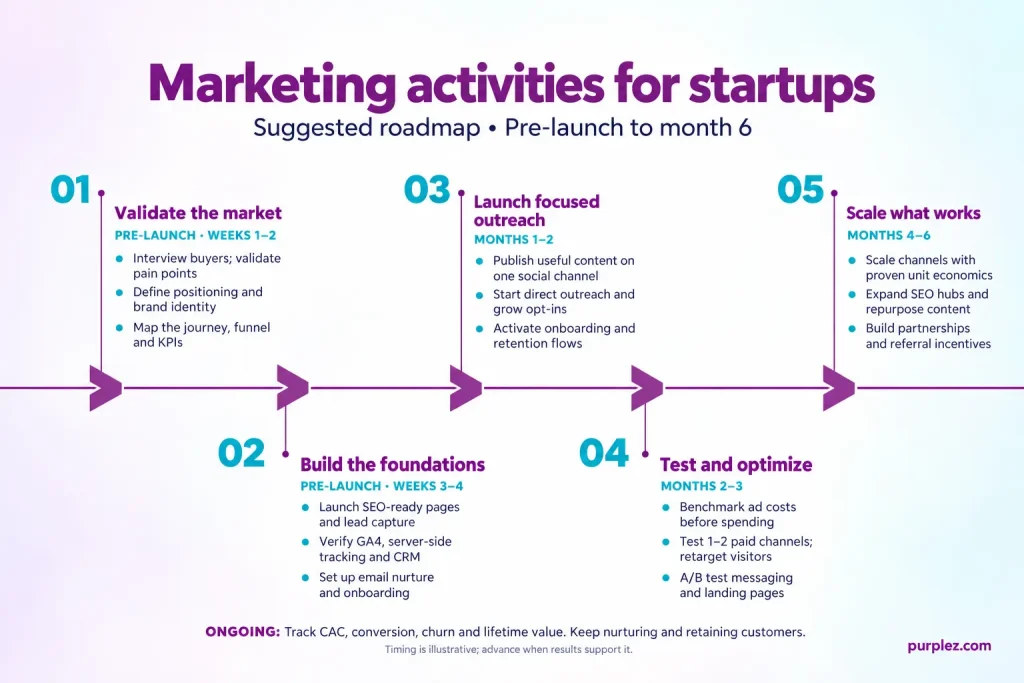
Lean market research identifies high-intent buyer pain points through customer discovery interviews, forums, and search demand analysis before drafting promotional copy. Uncovering the exact words customers use to describe operational challenges allows early ventures to position offerings with maximum clarity and relevance.
Mapping the Customer Journey
Customer journey mapping documents touchpoints a prospect navigates from initial problem awareness through evaluation, purchase, and renewal. Aligning outreach with decision stages prevents premature sales pitches that alienate buyers requiring foundational education.
Creating a Measurable Marketing Funnel
A measurable marketing funnel guides prospects through awareness, consideration, and conversion stages with qualification criteria and tracking pixels at transition points. Early ventures connecting top-of-funnel discovery to dedicated conversion rate optimization services capture demand without leaking qualified traffic.
Best-Performing Digital Marketing Strategies for Startups
Cost-Effective SEO Techniques for Early-Stage Companies
Early-stage companies build search authority affordably by targeting low-competition, long-tail queries reflecting commercial intent rather than broad keywords. Creating comprehensive answers satisfies user intent directly and earns organic rankings without massive backlink budgets, following Google Search Central guidelines. Applying tested digital marketing tips for startups accelerates search visibility across niche commercial queries.
Targeting Bottom-of-Funnel Long-Tail Keywords
Bottom-of-funnel keywords capture buyers comparing solutions and preparing to make an immediate purchasing decision. Targeting specific problem phrases yields higher conversion rates per visitor than high-volume informational keywords that attract casual browsers.
Building Search-Optimized Foundation Pages
Search-optimized foundation pages address primary service offerings with clear hierarchy, descriptive schema markup, and responsive technical architecture. Integrating professional SEO content writing ensures service pages satisfy search quality guidelines while guiding prospective clients toward consultations.
Establishing Topical Authority Through Content Hubs
Content hubs establish topical relevance by grouping related informational guides around a central pillar page linked through descriptive anchor text. This internal linking structure signals subject depth to search algorithms and keeps visitors engaged across related resources on your domain.
Creating Engaging Content Ideas For Each Channel
Engaging startup content educates prospective buyers by solving specific operational headaches with proprietary workflows, templates, and transparent founder insights. Embedding these creative tactics into a digital marketing strategy for startups builds credible authority far faster than publishing surface-level commentary or generic announcements.
Documenting Founder Insights and Behind-the-Scenes Lessons
Founders generate authentic engagement by sharing transparent post-mortems, prototype experiments, and operational lessons learned while building their venture. This narrative humanizes the organization, builds trust with early adopters, and sparks shareable industry discussions across professional networks.
Producing Actionable Frameworks, Checklists, and Templates
Utility-driven assets like downloadable calculators, audit checklists, and step-by-step implementation frameworks deliver immediate tangible value to prospects. Visitors exchange business contact details for practical tools that save time or simplify complex workflows.
Repurposing Core Assets Across Multiple Distribution Formats
Repurposing maximizes production efficiency by transforming one comprehensive research report into video summaries, episodic newsletter insights, and focused social discussions. Applying creative digital marketing tips for startups ensures high-value concepts reach diverse audience segments without requiring constant editorial creation from scratch.
Choosing the Right Social Media Platforms for Your Target Audience
Startups succeed on social media by concentrating engagement efforts on the single channel where their verified buyers actively consume professional solutions. Focusing creative resources on one primary platform prevents brand dilution and builds meaningful community relationships far faster than managing inactive profiles across numerous networks.
Identifying Where Your Target Demographic Engages
Audience discovery requires analyzing demographics, professional titles, and industry discussions across platforms to confirm where decision-makers spend time. Aligning channels with buyer habits ensures outreach engages prospects when they are receptive to operational solutions.
B2B Versus B2C Platform Alignment
B2B enterprises typically generate qualified leads through LinkedIn and industry discussion boards, whereas consumer brands thrive on visually rich platforms and short-form video. Partnering with dedicated social media marketing services ensures creative messaging, posting frequency, and community moderation match platform-specific consumption habits. Before selecting the social media platforms to work on, think about if the time and budget needed to produce high-quality content is affordable for you.
Developing a Consistent Publishing Cadence
Publishing consistent, value-first commentary establishes recognizable brand presence and trains network algorithms to distribute updates to relevant followers. Maintaining structured social media planning keeps communication active during demanding product development cycles.
How to Allocate Budget on Paid Ads as an Emerging Brand
Emerging brands must treat paid advertising as a scientific validation tool rather than an open-ended brand expenditure. Integrating targeted pay-per-click testing into a digital marketing strategy for startups allows founders to test messaging resonance, measure acquisition costs, and validate conversion pathways with minimal downside risk.
Do the Math Before Spending the Test Budget
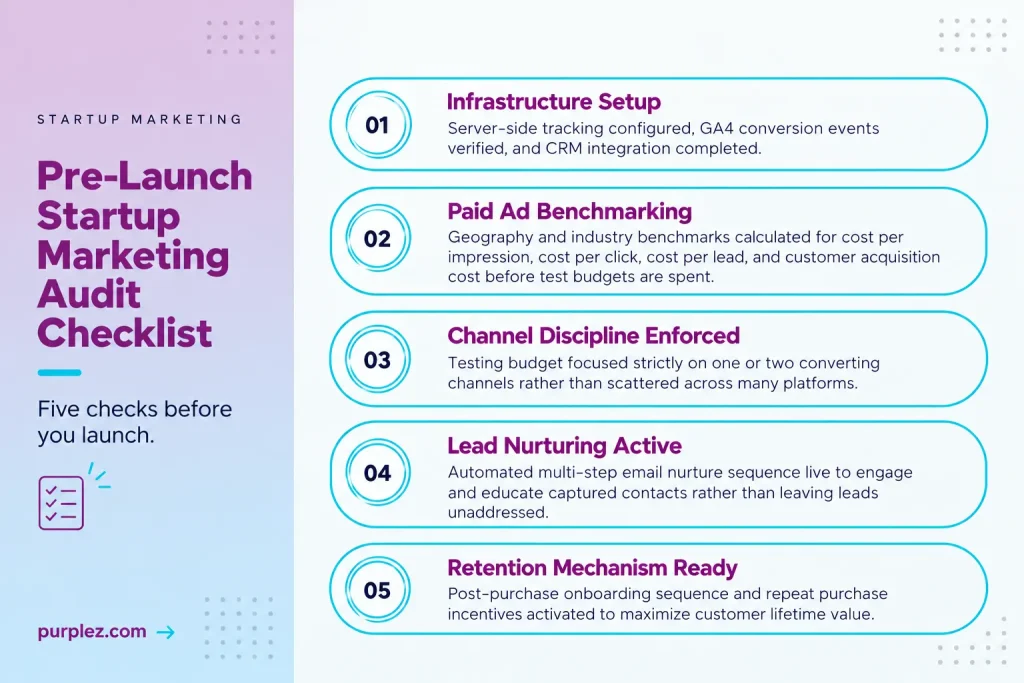
Founders must benchmark expected costs per impression, click, lead, and customer acquisition within their industry before spending test budgets. Calculating these metrics against the dedicated budget clarifies whether paid testing can yield result or tighten the budget.
Research Which Funnel Stage Each Paid Channel Targets
Different advertising channels address distinct buyer mindsets along the conversion funnel, requiring campaigns to match user intent directly. Video ads on platforms like YouTube introduce solutions to top-of-funnel audiences, whereas intent-driven search ads engage middle-of-funnel prospects actively evaluating operational alternatives.
Avoid Allocating a Lean Budget Across Too Many Channels
Spreading limited capital across multiple advertising platforms dilutes campaign data and prevents statistically meaningful conversion analysis. Concentrating your testing budget on one or two converting channels delivers clean performance insights and faster optimization than scattering funds across fragmented networks.
Implementing Retargeting to Recover Engaged Visitors
Retargeting campaigns re-engage previous site visitors who browsed service pages or pricing tables without completing an inquiry. Implementing actionable digital marketing tips for startups around retargeting recovers interested buyers at a fraction of initial acquisition costs.
| Marketing Area | Tips for Startups | Mistakes to Avoid |
| Customer Research | Interview potential customers, explore industry discussions, and analyze search demand to understand real problems and buying intent. | Assuming you know what buyers need or copying competitors without validating your audience. |
| Branding and Positioning | Establish clear positioning, consistent visuals, and messaging that explains why your solution matters. | Treating branding as optional and spending everything on direct-response campaigns. |
| Customer Journey | Map the path from awareness to purchase and renewal. Match content and calls to action to each stage. | Asking every prospect to buy immediately, including people who still need education and reassurance. |
| SEO Foundations | Build search-friendly service pages and target specific, high-intent keywords relevant to your offering. | Chasing broad, competitive keywords or attracting traffic with little purchase intent. |
| Content Creation | Share founder insights, practical frameworks, checklists, and templates. Repurpose useful assets across formats. | Publishing generic content or creating every post from scratch without a distribution plan. |
| Social Media | Focus on one primary platform where your buyers engage. Choose a publishing schedule your team can sustain. | Spreading resources across too many platforms or choosing channels without considering production costs. |
| Paid Advertising | Benchmark impression, click, lead, and acquisition costs before spending. Concentrate initial tests on one or two channels. | Committing large budgets to untested campaigns or dividing a lean budget across too many platforms. |
| Campaign Messaging | Match each ad’s message and offer to the audience’s intent and funnel stage. | Using the same sales pitch for cold audiences, active researchers, and returning visitors. |
| Tracking and CRM | Verify conversion events, attribution, server-side tracking, and CRM integration before scaling acquisition. | Spending on campaigns without reliable tracking or a clear connection between leads and revenue. |
| Email and Lead Nurturing | Build an opt-in list from day one and activate automated email sequences that educate and guide prospects. | Leaving captured leads without follow-up or relying entirely on third-party platforms for access to your audience. |
| Direct Outreach | Start relevant, personalized conversations with qualified prospects to complement inbound marketing. | Sending generic pitches that ignore the recipient’s needs or readiness to buy. |
| Testing and Optimization | Test headlines, calls to action, landing pages, and email subject lines. Document findings and allow enough data to guide decisions. | Making changes based on assumptions or declaring winners before results are meaningful. |
| Customer Retention | Prepare onboarding, check-ins, and relevant repeat-purchase incentives early. | Focusing exclusively on new customers while neglecting the experience after purchase. |
| Performance Measurement | Monitor customer acquisition cost, conversion rate, churn, and lifetime value to assess sustainable growth. | Judging success by traffic, impressions, or sales totals without considering costs and retention. |
| Partnerships | Collaborate with complementary businesses through shared guides, webinars, and referrals. | Trying to build every audience alone when relevant partners already serve your buyers. |
| Scaling | Increase investment in channels with repeatable results while continuing to develop organic and owned assets. | Scaling before validating acquisition economics or copying the spending patterns of established brands. |
Building a Data-Driven Growth Engine
A data-driven growth engine tracks customer acquisition metrics and conversion milestones across touchpoints to guide budget decisions. Grounding your digital marketing strategy for startups in verifiable user analytics allows leadership to eliminate budget waste and forecast expansion with mathematical confidence.
Establishing Reliable Analytics and Event Tracking
Reliable tracking architecture requires configuring clean conversion events, custom goals, and cross-domain tracking in analytics software before launching campaigns. Capturing exact form submissions and checkout completions ensures marketing teams evaluate channel performance using verified transaction records.
Monitoring Critical Unit Metrics Beyond Traffic
Founding teams must evaluate marketing efficiency through customer acquisition cost, conversion rate, churn rate, and customer lifetime value rather than vanity pageviews. Following data-oriented digital marketing tips for startups ensures website traffic translates into sustainable gross profit and healthy retention ratios.
Implementing Rapid A/B Testing
Data-driven growth relies on running weekly split tests on subject lines, landing page headlines, and call-to-action buttons. Documenting test results methodically allows teams to discard ineffective tactics quickly and double down on validated messaging variations.
Essential Digital Marketing Tips for Startups to Maximize Traction
Early ventures maximize commercial traction by combining lean distribution channels, technical domain hygiene, and targeted relationship-building. Reviewing practical digital marketing tips for startups enables founders to outmaneuver resource-heavy incumbents through speed, direct buyer communication, and disciplined execution across every campaign phase.
Build a Performance Marketing Infrastructure from the Beginning
Founders must implement server-side tracking, verified attribution modeling, and customer relationship management integration before scaling acquisition spend. Following technical digital marketing tips for startups when configuring tracking infrastructure ensures every dollar connects directly to verifiable pipeline revenue.
Cultivating an Owned Email List from Day One
An opt-in email list gives your organization direct, unfiltered access to prospective buyers without paying third-party platforms for visibility. In our guide on B2B email marketing that converts, we explain why a targeted database of 500 engaged subscribers regularly outperforms a rented contact list of 50,000 cold prospects.
Integrating Direct Messaging and Sales Outreach
Direct outreach to qualified prospects complements inbound marketing by initiating personal discovery conversations with decision-makers who need immediate solutions. Integrating outbound communication with foundational digital marketing tips for startups accelerates pipeline velocity during early market development phases.
Establish a Customer Retention Plan Early
Securing repeat purchases costs significantly less than acquiring first-time customers, making retention vital for unit economics. Automated onboarding, check-ins, and loyalty incentives turn initial transactions into recurring revenue with minimal incremental expenditure.
Prioritizing Organic and Owned Channels for Long-Term Efficiency
Focusing on organic search, owned email subscriber lists, and educational content assets yields significantly higher returns on lean budgets over the long run. While paid direct marketing stops generating traffic the moment spending halts, organic and owned channels compound domain authority over time, driving sustainable inbound leads at continually declining acquisition costs.
Leveraging Strategic Partnerships and Co-Marketing
Partnering with non-competing vendors who serve the same audience expands reach through joint webinars, co-authored guides, and mutual referrals. This collaborative model introduces your brand to receptive audiences while sharing campaign costs.
Common Mistakes to Avoid in a Digital Marketing Strategy for Startups
The most damaging mistakes in early marketing include burning capital on untracked promotions, chasing vanity sales figures, neglecting brand identity, copying giant incumbents, and misunderstanding buyer psychology. Avoiding these operational errors within a digital marketing strategy for startups keeps your growth trajectory resilient, cost-efficient, and aligned with sustainable profitability.
Spending Excessive Budget on Untested Channels
Allocating capital to unproven advertising platforms before validating message resonance rapidly drains startup cash reserves. Successful founders test with conservative budgets and scale investment only after establishing a repeatable, positive return on acquisition costs.
Targeting All Activities Exclusively at Immediate Sales
Focusing every asset exclusively on closing immediate transactions alienates prospects still researching options. Sustainable growth balances direct-response calls to action with educational nurturing content that guides buyers naturally toward purchasing decisions. Do not forget that you cannot target the bottom-of-funnel when you have no user at the top-of-funnel yet.
Failing to Nurture Generated Leads
Neglecting captured leads after initial opt-in wastes the acquisition budget by allowing interested prospects to disengage. Establishing automated multi-step email nurture sequences educates buyers, builds trust, and moves contacts deeper through the sales funnel.
Neglecting Branding Impact
Early-stage founders often dismiss branding expenses as a waste of budget, channeling all capital into direct-response marketing to chase immediate transactions. This mindset ignores that brand identity, clear positioning, and design consistency establish the foundational trust prospects need before buying. Without credible branding, cold outreach and direct advertisements struggle to convert, inflating customer acquisition costs.
Blindly Replicating Competitor Tactics
Copying the marketing playbooks of well-funded industry incumbents fails because mature enterprises possess massive brand equity and budgets designed for broad awareness. Implementing agile digital marketing tips for startups allows emerging brands to emphasize personalized customer care that large conglomerates cannot match.
Underestimating User Behavior Psychology
Marketers often assume customers make purely logical decisions, ignoring risk aversion, fear of implementation failure, and cognitive friction. Addressing professional risk and removing checkout friction increases conversion rates far more effectively than listing technical specifications.
Frequently Asked Questions About Digital Marketing Strategy for Startups
The answers below provide direct guidance for executing a digital marketing strategy for startups while applying proven digital marketing tips for startups across B2B and B2C sectors.
How much should an early-stage company budget for marketing?
Most early-stage companies allocate 10% to 20% of projected revenue toward marketing, prioritizing lean organic search, content creation, and small-scale paid testing before committing to substantial recurring retainers.
Which marketing channel delivers the fastest return for a new business?
Direct email outreach and high-intent search advertising deliver the fastest customer conversions by engaging active buyers, while investments in organic search and brand awareness compound value over time.
How long does it take for inbound content marketing to generate leads?
Inbound content marketing typically requires three to six months to build search authority and generate consistent organic leads, making it essential to pair foundational search optimization with active social distribution and direct outreach during the initial launch phase.
Can a startup manage digital marketing internally without an agency?
Early-stage startups benefit most from a hybrid model: retaining core brand positioning and customer discovery in-house while outsourcing specialized execution like technical SEO, paid advertising, and web optimization to an experienced marketing agency. This approach avoids full-time payroll overhead while granting immediate access to multi-disciplinary experts and enterprise software tools.
How do founders know when a marketing channel is failing?
A marketing channel is failing when customer acquisition costs consistently exceed customer lifetime value after thorough messaging and audience testing, signaling that resources should be redirected to channels demonstrating validated conversion efficiency.
Final Strategic Verdict: Executing Sustainable Startup Marketing
A successful digital marketing strategy for startups is not built by outspending competitors, but by out-executing them through precision targeting, rapid messaging validation, and disciplined financial control. By mapping customer journeys, targeting high-intent organic search queries, and leveraging practical digital marketing tips for startups, founding teams create a compounding growth asset that converts interest into revenue.
Founders who master data-driven unit economics and avoid premature ad spend scale systematically without jeopardizing operational runway. If your organization is preparing to launch or refine its growth engine, partner with our experienced team at PurpleZ through our digital marketing consulting services to audit your market positioning, optimize conversion pathways, and build sustainable enterprise value.


